The water in your tap is one boil-water notice, one busted main, or one storm away from unsafe — and most people have no backup plan. The good news: you do not need expensive gear to make questionable water safe to drink. Here are seven proven methods, ranked by how fast, cheap, and reliable they are, plus exactly when to reach for each one.
Before you start: two rules for all seven
- Pre-filter cloudy water first. If the water is murky or full of debris, pour it through a coffee filter, clean cloth, or paper towel before you purify. Particles shield microbes and weaken every method below.
- Know what you are removing. Most of these methods kill germs (bacteria, viruses, parasites). Only distillation reliably removes chemicals, heavy metals, and salt. If you suspect chemical contamination, skip straight to method 7.
1. Boiling
The simplest method, and the one that always works if you have heat.
- Bring the water to a rolling boil for 1 full minute (3 minutes if you are above 6,500 feet of elevation).
- Let it cool on its own — do not add ice.
Kills bacteria, viruses, and parasites. Best for any time you have a heat source. It will not remove chemicals or clear up cloudy water.
2. Water Filter
A good filter is the fastest reusable option and the backbone of most kits.
- Pump, squeeze, or gravity-feed the water through the filter element.
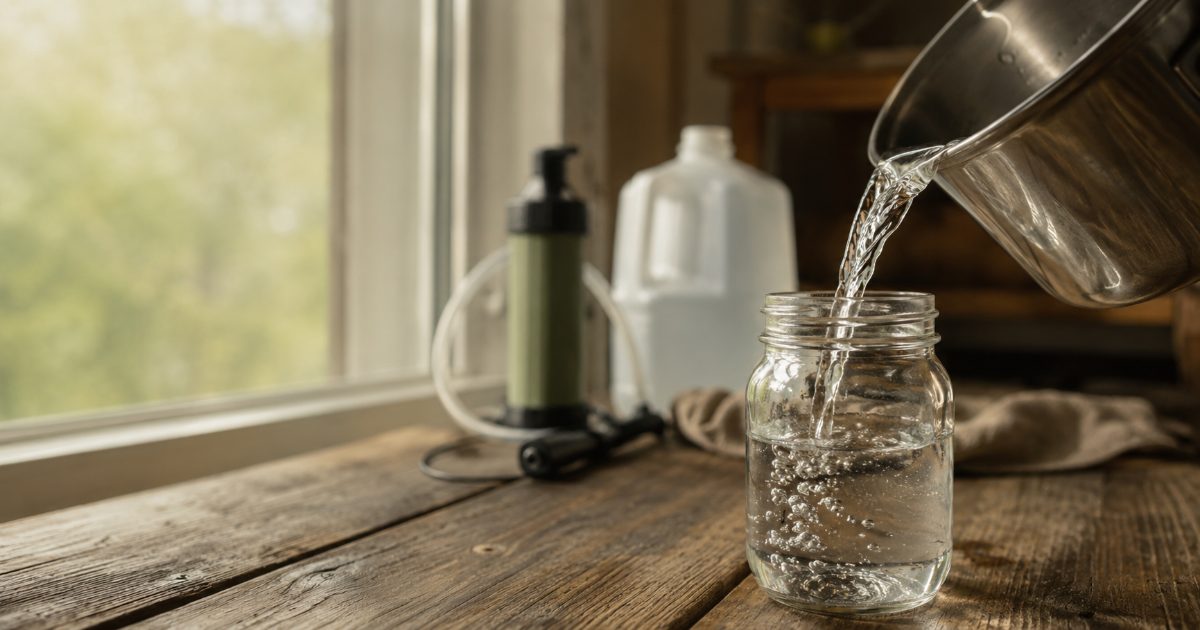
- A quality hollow-fiber filter like the sawyer-squeeze removes bacteria and protozoa and lasts for thousands of gallons.
Important: most field filters do not remove viruses — they are too small. In the U.S. backcountry that is usually fine, but for international travel or sewage-contaminated water, pair filtering with a second method below.
3. Purification Tablets
Lightweight insurance that lives in every bag.
- Drop chlorine-dioxide or iodine tablets into clear water.
- Wait the time on the package — usually 30 minutes, up to 4 hours for the toughest parasites.
A bottle of aquatabs weighs almost nothing and stores for years. Choose chlorine-dioxide over iodine: iodine does not reliably kill Cryptosporidium and is not safe for pregnant women or long-term use.
4. Bleach (Unscented)
The method hiding under your kitchen sink.
- Use plain, unscented household bleach (6%, with no additives or "splash-less" versions).
- Add 8 drops per gallon of clear water — 16 drops if it is cloudy.
- Stir, then wait 30 minutes. The water should have a faint chlorine smell. If it does not, repeat the dose once and wait again.
Best for treating large amounts at home. Bleach loses strength over 6 to 12 months, so rotate your supply.
5. UV Purifier
Light instead of chemicals.
- Stir a UV pen through clear water for 60 to 90 seconds per liter.
- The ultraviolet light scrambles bacteria, viruses, and protozoa so they cannot reproduce.
A rechargeable uv-purifier-pen treats clear water in about a minute and adds nothing to the taste. It needs battery power, and the water must be clear — cloudy water blocks the light.
6. Solar (SODIS)
The no-gear, no-cost method the World Health Organization actually recommends.
- Fill a clear plastic (PET) or glass bottle with clear water.
- Lay it on its side in direct sun for at least 6 hours — or 2 full days if it is overcast.
The sun's UV rays and heat disinfect the water with no fuel and no chemicals. The trade-off: it is slow, needs sunshine and clear water, and does not remove chemical contamination.
7. Distillation
The heavy hitter — the only method here that removes chemicals and salt.
- Boil water and capture the rising steam.
- Let that steam condense back into a separate clean container.
Because only pure water vapor rises, distillation removes pathogens, chemicals, heavy metals, and even salt — making it the only option for purifying seawater or chemically contaminated water. It is slow and fuel-hungry, so save it for the water nothing else can fix.
Frequently asked questions
How long can you store purified water?
Properly stored water stays safe for about 6 months. Keep it sealed in clean, food-grade containers, out of direct sunlight, and somewhere cool. Label the date and rotate every 6 months. If it ever looks cloudy or smells off, re-treat it before drinking.
Does boiling remove chemicals or lead from water?
No. Boiling kills germs but does nothing to remove chemicals, lead, or other dissolved contaminants — and as water evaporates it can actually concentrate them. If chemical or heavy-metal contamination is the concern, distillation or a certified filter is the only safe choice.
Can you drink rainwater or pool water in an emergency?
Rainwater is generally safe to collect and then purify using any method above. Pool water is risky: it often contains chemicals and algaecides that purification cannot remove, so use it only for non-drinking needs like flushing or cleaning unless you can distill it.