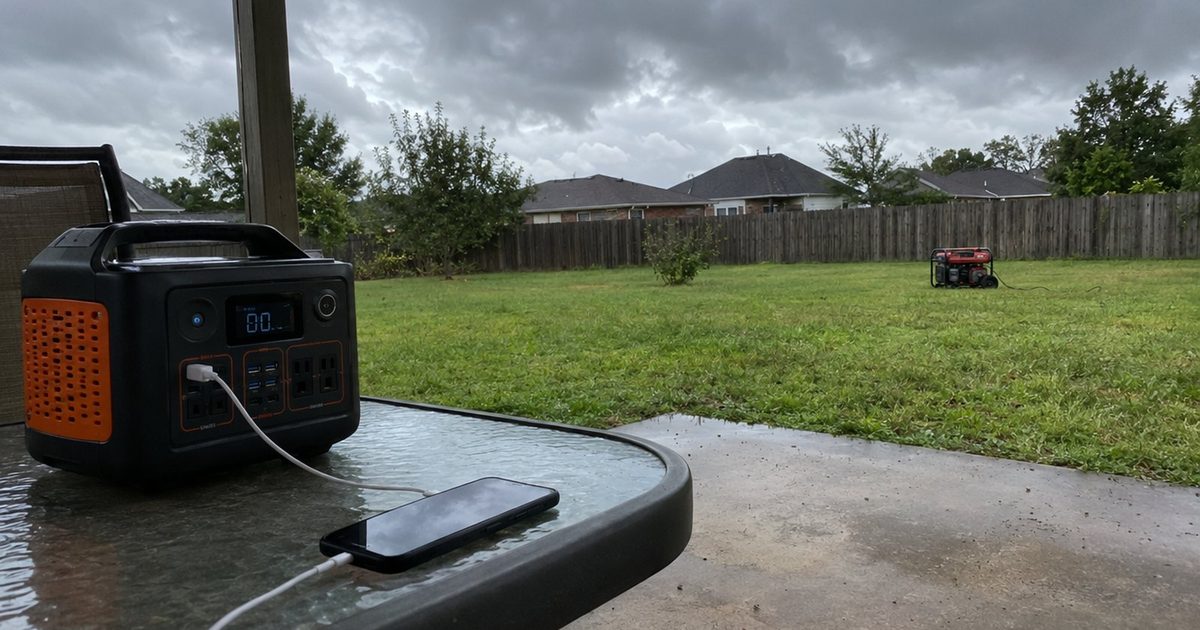
When the power goes out during storm season, everyone starts asking the same question: should I get a generator or one of those battery power stations? Both can keep your essentials running, but they're built for different jobs, and picking the wrong one can mean wasted money, or a real safety risk.
Here's a plain comparison of the two, and a simple way to decide which one fits your household.
The Quick Difference
- A gas generator burns fuel to make electricity. It can produce a lot of power for a long time, as long as you keep feeding it fuel.
- A portable power station is a large rechargeable battery with outlets and USB ports. It runs silently, makes no fumes, and can be recharged from the wall, your car, or solar panels.
Side by Side
Power Output
Generators win here. A mid-size gas generator can run a refrigerator, a sump pump, a well pump, a space heater, and lights at the same time. A power station can run several smaller things at once, and larger units can handle a fridge for a while, but they hit their limit sooner.
Safety
Power stations win, and it's not close. Gas generators produce carbon monoxide, an invisible, odorless gas that kills people every storm season. A generator must always run outdoors, at least 20 feet from the house, never in a garage, basement, or carport. A power station makes no fumes, so it's safe to use right next to your bed. Our guide to carbon monoxide safety during power outages covers this in detail.
Noise
Power stations win. They're silent or close to it. Generators are loud, which matters at night, in neighborhoods, and if you have an HOA.
Fuel and Runtime
Generators can run as long as you have fuel, but fuel is a problem in long outages. Gas stations need power to pump, and stored gasoline goes stale over time. Power stations run until the battery is empty, then need recharging. Pair one with a folding solar panel like the Renogy 100W Folding Solar Panel, and you can recharge every sunny day without any fuel at all.
Maintenance
Power stations are basically maintenance-free. Charge them every few months. Generators need oil changes, fuel stabilizer, and regular test runs, or they may not start when you need them.
Cost
For the same amount of power, generators usually cost less upfront. Power stations cost more per watt but have no ongoing fuel costs.
Which One Is Right for You?
Choose a power station if:
- You mainly need phones, lights, a Wi-Fi router, a laptop, or a CPAP machine.
- You live in an apartment, condo, or anywhere you can't safely run a generator outside.
- You want something you can use indoors, quietly, with zero fumes.
Good options include the Jackery Explorer 1000 v2 Power Station and the EcoFlow Delta 3 Power Station.
Choose a generator if:
- You need to run big loads like a full-size fridge, a well pump, a sump pump, or central heating equipment for days.
- You have a safe outdoor spot at least 20 feet from the house, and you're comfortable storing fuel safely.
- You're willing to do the regular maintenance.
Consider both if you're in a high-risk area with long outages. Many households use a generator for big loads during the day and a power station for quiet, safe power overnight.
How Much Power Do You Actually Need?
Make a short list of what you'd want running during an outage. Rough examples:
- A Wi-Fi router uses about 10 watts.
- A phone charge uses a small amount of energy.
- A CPAP without its heated humidifier often uses around 30 to 60 watts.
- A full-size refrigerator runs on and off and pulls a big burst of power when it starts.
If your list is mostly small electronics, a power station covers it. If it includes a fridge, a well pump, and heating equipment for days at a time, you're in generator territory. Our Power Outage Essentials for El Niño Storm Season walks through sizing in more detail.
A Word on Storing Fuel
If you go the generator route, fuel is part of the deal. Store gasoline only in approved fuel containers, outside your living space, away from heat and flames, and never in your house or basement. Add fuel stabilizer if it'll sit for more than a month, and rotate it into your car regularly so it doesn't go stale. Never refuel a generator while it's running or still hot.
Whichever You Choose
- Get a battery CO alarm. A Kidde Battery-Powered CO Detector still works when the power's out.
- Never plug a generator into a wall outlet to power your house. It can send electricity back into the power lines and seriously hurt utility workers. Whole-home setups need a transfer switch installed by a licensed electrician.
- Charge or test your equipment at the start of storm season, not the night of the storm.
Frequently Asked Questions
Is a power station or a generator better for a power outage?
For phones, lights, a router, and small medical devices, a power station is safer and easier. For big loads like a fridge, well pump, or heating equipment over several days, a generator delivers more power.
Can I use a power station indoors?
Yes. Power stations produce no fumes, so they're safe to use indoors. Gas generators must always run outside.
Can a power station run a refrigerator?
Larger power stations can run a fridge for a while, especially if you run it in cycles. Check that the unit can handle the fridge's startup surge.
How far from the house should a generator be?
At least 20 feet, with the exhaust pointed away from windows, doors, and vents.