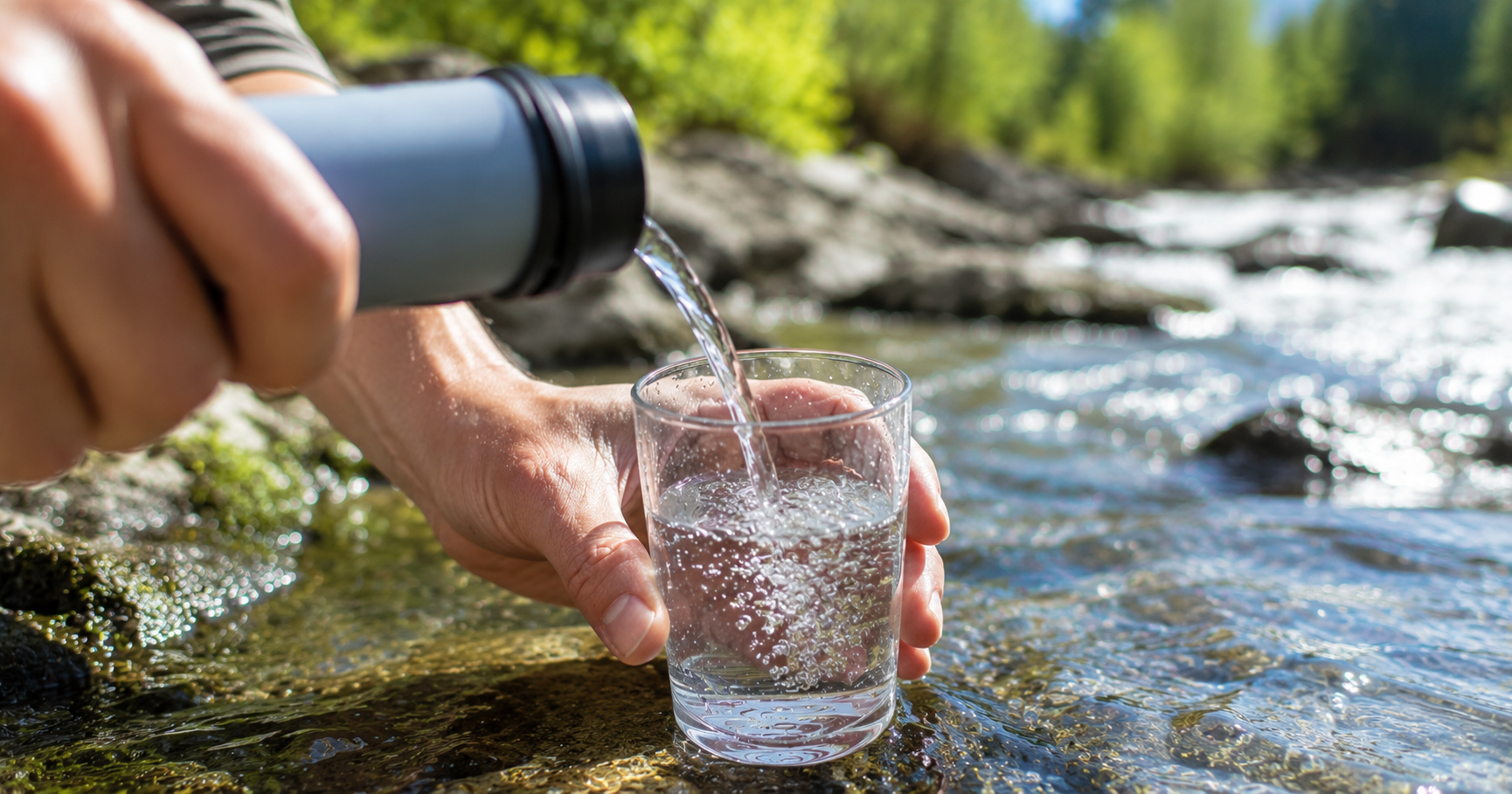
Water is the first thing you run out of and the hardest to store in quantity — a gallon a day per person adds up fast. That is why a filter is one of the highest-value items in any preparedness kit: it turns questionable water into safe drinking water without the weight of storing it all.
We compared the leading emergency water filters on what actually matters — what they remove, how much they process, and who they suit — and ranked the ones worth owning.
What to look for in an emergency water filter
- What it removes. Most filters handle bacteria and protozoa (the common culprits). Removing viruses requires a purifier or chemical treatment — relevant mainly for international or heavily contaminated sources.
- Capacity. How many gallons before it is used up. Pocket filters do thousands; gravity systems do tens of thousands.
- Flow and effort. Pump, squeeze, suck, or gravity-fed. Gravity is effortless for a household; straws are simplest for one person on the move.
- Portability vs. volume. A pocket straw is great in a bug-out bag; a counter-top gravity system is better for sheltering at home with a family.
At a glance: our ranked picks
| Filter | Best for | Type | Standout |
|---|---|---|---|
| Sawyer Squeeze | Best overall | Squeeze / inline | Huge capacity, versatile |
| Big Berkey | Best for households | Gravity | Filters large volumes hands-free |
| LifeStraw Personal | Best budget / EDC | Straw | Cheap, simple, packable |
| Grayl GeoPress | Best for viruses/travel | Press purifier | Removes viruses too |
| Katadyn Hiker | Best pump | Pump | Fast, field-proven |
1. Best overall: Sawyer Squeeze
The Sawyer Squeeze is the filter we recommend to most people. It is inexpensive, packable, and rated to filter an enormous volume over its life. It works as a squeeze filter, inline on a hydration pack, or attached to standard bottles, which makes it genuinely versatile across home and bag. For the price and capacity, nothing else matches its value.
Best for: Almost anyone — a couple, a bug-out bag, or a backup at home.
Worth knowing: It handles bacteria and protozoa, not viruses; for that, pair it with treatment or choose a purifier.
See Details
2. Best for households: Big Berkey
When you are sheltering at home with a family, you want volume without effort. The Big Berkey gravity system sits on the counter, holds a large reservoir, and filters water hands-free using gravity — no pumping, no squeezing. Pour questionable water in the top, draw clean water from the spout. For a household riding out a longer outage or boil-water advisory, it is the most practical option.
Best for: Families and anyone sheltering in place.
Worth knowing: It is bulky and not meant to be carried — this is a home solution, not a bug-out one.
See Details
3. Best budget / everyday carry: LifeStraw Personal
The LifeStraw Personal Water Filter is the cheapest reliable way to make water safe. You drink directly through it from a stream, bottle, or container. It is tiny, light, and rated to filter thousands of gallons, which makes it perfect to tuck into every bag, car, and kit you own. It is the easiest "everyone should have one" pick on this list.
Best for: Budget buyers, everyday carry, and stashing one everywhere.
Worth knowing: You drink through it directly, so it is best as a personal filter rather than for filling containers for others.
See Details
4. Best for viruses and travel: Grayl GeoPress
If your water sources might include viruses — international travel, urban flooding, heavily contaminated water — most filters are not enough. The Grayl GeoPress is a press-style purifier: fill the outer cup, press the inner cup down, and in seconds you have purified water that addresses viruses as well as bacteria and protozoa. It is fast and foolproof.
Best for: Travel, urban scenarios, and anyone wanting virus protection.
Worth knowing: It costs more and purifies a bottle at a time, so it is less suited to high-volume household use.
See Details
5. Best pump: Katadyn Hiker
The Katadyn Hiker is a field-proven pump filter that lets you draw water from shallow or awkward sources and fill your own containers quickly. Pumping gives you control and speed that straws and squeeze filters lack, which is handy when filling bottles for a group on the move.
Best for: Filling containers for a group, and drawing from shallow sources.
Worth knowing: Pumping takes effort and the unit has more moving parts than a simple straw or squeeze filter.
See Details
How to choose
- One person, on the move? A LifeStraw or Sawyer Squeeze covers you cheaply.
- A household at home? A Big Berkey gravity system gives you volume with no effort.
- Worried about viruses or traveling? A Grayl GeoPress purifies, not just filters.
- Filling containers for a group? A Katadyn Hiker pump is fast and controllable.
Honestly, many households end up with two: a gravity system for home and a packable filter for each bag.
What a filter does not solve
A filter makes found water safe, but you still want some stored water for immediate use and for when no source is nearby. Pair a filter with stored water — see our guide to water storage — and you have both bases covered.
Frequently asked questions
Do water filters remove viruses?
Most do not. Standard filters remove bacteria and protozoa. To address viruses you need a purifier (like the Grayl GeoPress) or chemical treatment. For most domestic emergencies a filter is enough; viruses are mainly a concern with international travel or heavily contaminated water.
How long do emergency water filters last?
It varies widely by type. Pocket straws and squeeze filters are often rated for thousands of gallons, while gravity-system elements can last for thousands of gallons per set of filters. Always check the manufacturer's rating and replace elements on schedule.
Is a filter better than storing water?
They solve different problems. Stored water is instantly available with no source needed; a filter lets you make far more water safe than you could ever store. The best setup uses both — store some, and keep a filter to extend your supply.