Water is the first thing you run out of in an emergency and by far the hardest to improvise. You can stretch food, sleep cold, and live without power, but a person needs water every single day, and El Niño storms can contaminate or cut municipal water for days at a stretch. That makes water storage one of the highest-value, lowest-cost things you can do to prepare for the 2026 season. The good news is the math is simple, and you can start this week. This guide supports the main El Niño prep guide.
The one-gallon rule
The foundation of all water storage is this: one gallon per person, per day. Roughly half of that is for drinking, and the other half covers cooking, basic hygiene, and cleaning. This is the FEMA and Red Cross baseline, and it's the number every other calculation builds from. In hot climates, for nursing mothers, or for anyone ill, plan for more.
Scale it to your household
Take the one-gallon rule and multiply it out:
- Minimum (3 days): 3 gallons per person — the absolute floor, suitable only for short outages.
- Recommended (2 weeks): 14 gallons per person — the realistic target for El Niño season, when storms and outages can stretch on.
- Family of four, 2 weeks: 56 gallons.
Two weeks is the goal worth building toward, because El Niño disruptions frequently last longer than the three-day window most people plan for. If 56 gallons sounds like a lot, remember it's spread across containers and built up gradually — you don't buy it all at once.
Don't forget pets and special needs
Animals need water too. Plan for roughly one ounce per pound of body weight per day — about a half-gallon daily for a 50-pound dog. Add extra for any household member who is pregnant, nursing, elderly, or managing a medical condition, and a little more for cleaning wounds and basic sanitation during a prolonged event.
Store it the right way
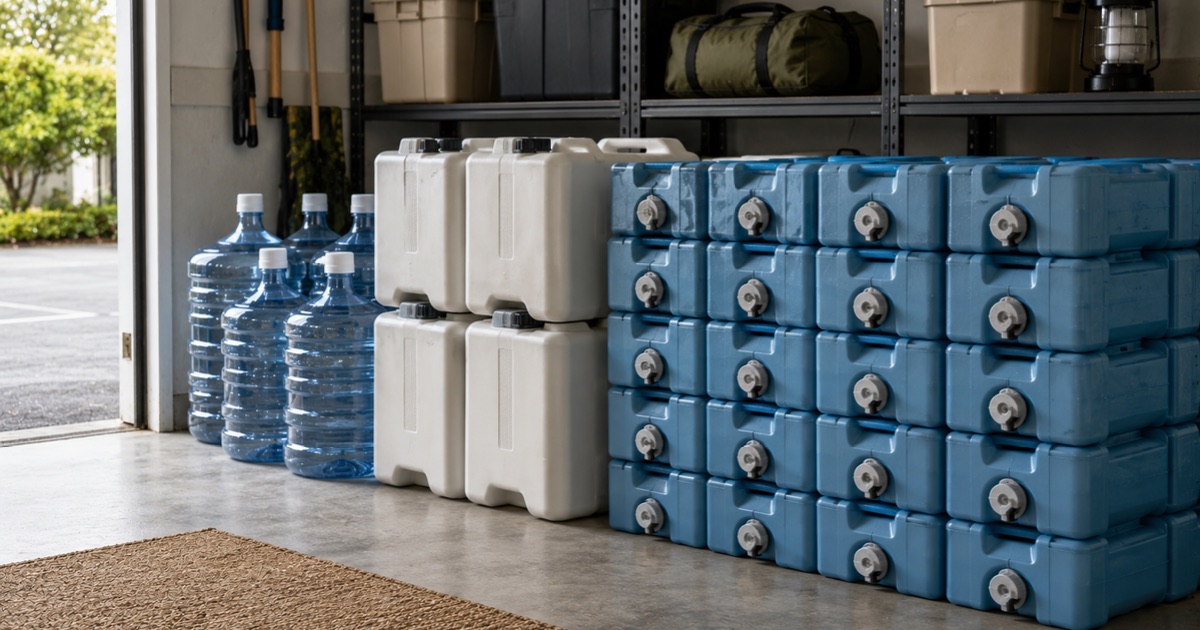
Use only food-grade containers designed for water. Rigid, stackable jugs like the aqua-tainer are ideal because they store efficiently and stack to save floor space, and modular waterbrick containers interlock for organized, space-saving storage in closets or under beds. Keep all stored water somewhere cool, dark, and dry, away from direct sunlight and from chemicals or fuel whose vapors can permeate plastic. In winter regions, store it where it won't freeze.
Rotate and label
Commercially sealed bottled water lasts until its printed date and is the most convenient option. Water you bottle yourself in clean food-grade containers should be refreshed about every six months for best taste and safety. Label every container with the date you filled it, and rotate the oldest first. Set a calendar reminder so it actually happens.
Always keep a backup filter
Here's the reality: stored water eventually runs out, but a good filter doesn't. A sawyer-squeeze lets you make questionable water safe to drink once your stored supply is gone — and during an El Niño flood, when the tap is contaminated, that capability is priceless. Storage plus a filter is the complete answer: storage covers the immediate days, and the filter extends your options indefinitely as long as you can find a water source. For the full range of emergency purification methods, see 7 ways to purify water.
How to build your supply without breaking the bank
You don't need to buy 56 gallons in one trip. Add a few containers or a case of bottled water each shopping trip, and you'll hit a two-week supply within a couple of months for very little money. Cleaned and sanitized food-grade jugs work well for self-filled storage. The key is to start now, before the season peaks and before a storm sends everyone to the store at once.
Frequently asked questions
Can I just store store-bought bottled water?
Yes — commercially sealed bottled water is convenient, safe, and has a long shelf life. Note the printed expiration dates, keep it out of direct sunlight, and store it away from gasoline, pesticides, and other chemicals whose fumes can pass through the plastic over time.
How long does stored water last?
Commercially sealed water lasts until its printed date. Water you bottle yourself in clean, sanitized, food-grade containers should be rotated roughly every six months for best taste and safety. Properly stored, water doesn't truly "go bad," but it can pick up off flavors and, in poor containers, contamination.
What if I run out of stored water?
Use a filter or another purification method on the cleanest source you can find — a stream, rain you've collected, or even questionable tap water under a boil notice. A backup filter is exactly why every water plan should include one. See 7 ways to purify water for your options.
Is it safe to store water in old milk or juice jugs?
It's not recommended. Milk jugs in particular are hard to fully clean of sugars and proteins, which can breed bacteria, and they degrade and leak over time. Use purpose-made water containers or sanitized food-grade jugs intended for long-term storage.
How much water do I need just for drinking versus everything else?
Plan on roughly a half-gallon per person per day for drinking alone, with the other half-gallon covering cooking and hygiene. In hot weather or with physical exertion, drinking needs rise, so the full one-gallon figure gives you a sensible cushion.
Does water storage take up a lot of space?
Less than you'd think with the right containers. Stackable jugs and modular interlocking bricks use vertical space efficiently and fit in closets, under beds, or in a garage corner. A two-week supply for a small household fits in a surprisingly compact footprint when the containers are designed to stack.