El Niño is about to drop a tremendous amount of rain on much of the country — and in most homes, nearly all of it will rush straight down the gutter and into the storm drain, gone. Capturing even a fraction of that runoff gives you free water for your garden, for cleaning, and as an emergency backup supply. Rainwater harvesting turns a storm-season liability into a genuine asset, and El Niño gives you more raw material to work with than usual. Here's how to set it up the smart way. This pairs with drought prep and the main prep guide.
Understand how much you can actually collect
The numbers are bigger than people expect. A single inch of rain falling on a 1,000-square-foot roof yields over 600 gallons of water. In a wet El Niño winter with many inches of rain, a modest system of a few barrels can capture hundreds of gallons that would otherwise be lost. Once you see how much runs off even a small roof, the case for catching some of it becomes obvious.
Add barrels to your downspouts
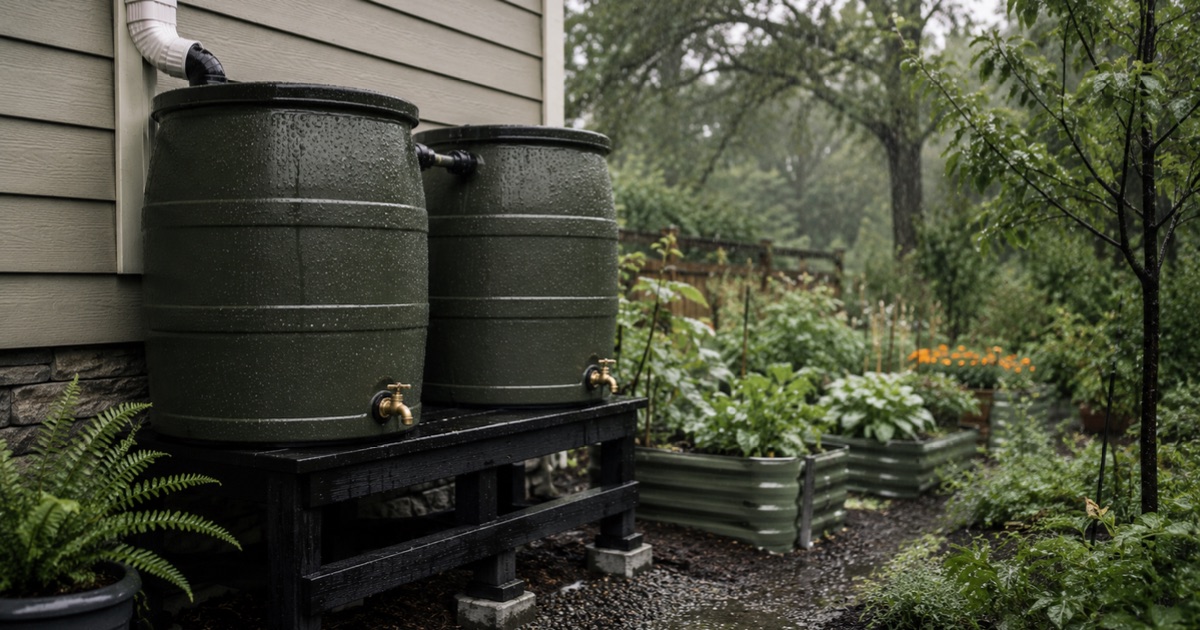
The simplest entry point is a rain barrel positioned under a downspout to catch roof runoff. Choose food-grade barrels if you intend to use the water for anything beyond the garden, and position them at your highest-volume downspouts for the best yield. A basic barrel with a spigot and an overflow outlet costs little and installs in an afternoon, making it the natural first step.
Use a first-flush diverter
The first water that comes off your roof in a storm carries the most contamination — accumulated dust, pollen, bird droppings, and debris. A first-flush diverter automatically routes that initial dirty flow away before clean water begins filling your barrel. It's an inexpensive add-on that meaningfully improves the quality of what you collect, especially important if the water will touch edible plants.
Screen out debris and mosquitoes
Cover every barrel opening and inlet with fine mesh screen. This keeps leaves and debris from clogging the system and, just as importantly, prevents mosquitoes from breeding in the standing water — a real concern with any open water storage. Keeping the system sealed and screened protects both the water and your yard.
Link barrels to store more
A single barrel fills fast in heavy El Niño rain and then simply overflows. Connect several barrels in series, so that when the first fills, it feeds the next, and the next. This multiplies your storage capacity without the cost or footprint of one large cistern, and it's easy to expand over time as you see how much rain your roof actually delivers.
Elevate barrels for usable pressure
Rain barrels rely on gravity, so raising them on a sturdy, level stand or platform gives you usable water pressure at the spigot — enough to fill watering cans easily or even run a soaker hose. Make sure the stand is solid, because water is heavy: a full 55-gallon barrel weighs over 450 pounds. A stable, elevated setup is far more pleasant to actually use.
Filter and treat before any drinking use
This is the safety rule that matters most. Harvested rainwater is excellent for gardens, lawns, and outdoor cleaning exactly as collected. But for drinking, washing dishes, or bathing, it must be properly filtered and treated first, because roof runoff picks up contaminants along the way. Run it through a quality filter like a big-berkey gravity system or a sawyer-squeeze, and disinfect it, before any consumption. Never assume collected rainwater is drinkable straight from the barrel.
A simple starter setup
You don't need an elaborate system to begin. A solid starter is a single food-grade 55-gallon barrel placed on a sturdy elevated stand under your highest-volume downspout, fitted with a screened inlet, a spigot near the bottom, and an overflow outlet directed away from the foundation. Add a basic first-flush diverter if you can. That's it — for a modest cost and an afternoon's work, you'll start capturing hundreds of gallons over a wet El Niño winter. Once you see how quickly it fills, you can link in additional barrels to expand your capacity. Starting small and simple gets you collecting now rather than waiting for the perfect system.
Frequently asked questions
Is it legal to collect rainwater?
In most U.S. states it's perfectly legal, and many areas actively encourage it with rebates for rain barrels and cisterns. A few states do regulate large-scale collection, so check your state and local rules before installing a big system. For typical homeowner rain barrels, restrictions are rare.
Can I drink harvested rainwater?
Not without treatment. Roof runoff collects dust, debris, droppings, and other contaminants, so it must be filtered and disinfected before drinking, cooking, or bathing. Untreated, it's fine for gardens, lawns, and outdoor cleaning, but never assume it's safe to drink straight from the barrel.
How much rainwater can I realistically collect?
Roughly 600 gallons for every inch of rain that falls on 1,000 square feet of roof. In a wet El Niño winter, even a few linked barrels can capture hundreds of gallons over the season — enough to make a real dent in garden watering and provide emergency backup.
Will rain barrels attract mosquitoes?
Only if left open. Covering all openings with fine mesh screen and keeping the system sealed prevents mosquitoes from breeding entirely. Using the stored water regularly also keeps it from sitting stagnant, which further discourages them.
What kind of barrel should I use?
A food-grade barrel with a sealed lid, a screened inlet, a spigot near the bottom, and an overflow outlet is ideal. If you plan to ever filter the water for drinking, food-grade is essential. Dark or opaque barrels also discourage algae growth compared with clear ones.