
Most storm prep advice assumes you own the place. Clean the gutters. Install a sump pump. Regrade the yard. If you rent, you can't do most of that, and you shouldn't have to.
Here's the good part. The things that protect you the most as a renter don't involve a single nail. They're about your stuff, your paperwork, your plan and your landlord. Let's walk through it.
Why This Winter Is Worth a Little Extra Effort
NOAA's Climate Prediction Center said on October 8, 2026, that a "strong-to-very strong El Niño" is likely through January-March 2027. In much of the southern US, including California, Texas, the Gulf Coast and the Southeast, El Niño winters tend to be wetter. Up north they tend to be milder. Not sure what's typical where you live? Check Does El Niño 2026 Affect My Region?
None of that is a guarantee. It just means it's a good year to get your basics in order.
1. Find Out What Your Renters Insurance Actually Covers
This is the big one, and most people never check.
Federal guidance from FEMA and Ready.gov says homeowners and renters insurance typically do not cover flood damage. Your landlord's policy covers the building, not your couch, laptop or clothes.
What to do:
- Pull up your renters policy and search for the word "flood." See what's excluded.
- If you don't have renters insurance, Ready.gov recommends getting property coverage, "homeowners or renters," if you don't have it.
- Ask your agent about flood coverage for your belongings.
The good news: You can get flood insurance as a renter. The National Flood Insurance Program (NFIP) sells contents-only policies. According to FloodSmart.gov, "Renters flood insurance policies protect the things you own inside your home," with coverage up to $100,000 for belongings.
The catch: Timing. FloodSmart.gov says coverage "will go into effect 30 days after your date of purchase" in most cases. So if you're going to do it, do it now, not when the forecast turns ugly. You can get an estimate at FloodSmart.gov.
2. Have a Friendly Talk With Your Landlord
You don't need to make it a big deal. A short message works. Ask:
- Have the gutters and drains been cleared this fall?
- Is there a sump pump, and does it have backup power?
- Where are the main water shutoff and the breaker panel?
- What's the plan if the unit floods or loses heat? Who do I call after hours?
- Is it OK if I put a weather strip or door sweep on my door, or would you rather handle it?
Get the answers in writing, even just a text thread. That helps everyone if something goes wrong later.
3. Photograph Everything You Own
If you ever need to file a claim, photos make it much easier. Ready.gov recommends you "make a record of your personal property for insurance purposes" and take "photos or a video of the interior and exterior of your home."
A renter-friendly way to do it:
- Walk room to room with your phone recording video. Open closets and drawers.
- Say out loud what the bigger items are as you go.
- Snap close-ups of serial numbers on electronics.
- Take photos of the unit itself on move-in day or now, so you can show what condition it was in.
- Upload it all to cloud storage so it doesn't live only on your phone.
This takes about 30 minutes and it's the cheapest prep on this list.
4. Protect Your Papers
Ready.gov suggests keeping important documents "in a waterproof container" and creating "password-protected digital copies."
Put these in a waterproof pouch or small box:
- IDs and passports
- Your lease and insurance policy
- Birth certificates and Social Security cards
- Medication list and doctor contacts
- A few emergency contacts written on paper, in case your phone dies
5. Lift Your Stuff Up (No Tools Needed)
You can't flood-proof the building. You can keep your things out of the first few inches of water.
- Store important boxes on shelves or furniture instead of the floor.
- Use plastic bins with lids instead of cardboard in closets and storage units.
- Move electronics and power strips up off the floor, especially if you're on a ground floor or in a basement unit.
- Keep a few towels handy for minor leaks around doors and windows.
6. Block Drafts and Small Leaks the Renter-Friendly Way
Up north, where El Niño winters often run milder, you'll still get cold nights. Down south, wind-driven rain finds every gap. A few no-damage fixes help:
- Door draft stoppers that slide under the door. No adhesive, no holes.
- Removable window insulation film or thick curtains. Check with your landlord first if you're using anything that sticks.
- Rolled towels along window sills during heavy rain.
7. Plan for a Power Outage
Storms knock out power, and renters often can't install a generator hookup. Portable options work well.
- A portable power station can keep phones, lights and small devices running. Our Best Portable Power Stations for Outages guide compares options.
- Flashlights or lanterns instead of candles, plus extra batteries.
- A backup battery for each phone, kept charged.
- A battery or hand-crank radio. Ready.gov lists a NOAA Weather Radio in its basic kit. See Best Emergency Weather Radios.
One safety rule: if you use a gas generator, never run it indoors, in a garage or on an enclosed balcony. The National Weather Service says, "Never run a generator in an enclosed space." In an apartment, that usually means a power station is the safer choice.
More ideas: Power Outage Prep: Storm-Season Survival in 8 Steps.
8. Pack a Go-Bag
Renters, especially in apartments, can be asked to leave because of building issues even when their own unit is fine. A packed bag makes that a calm exit instead of a scramble.
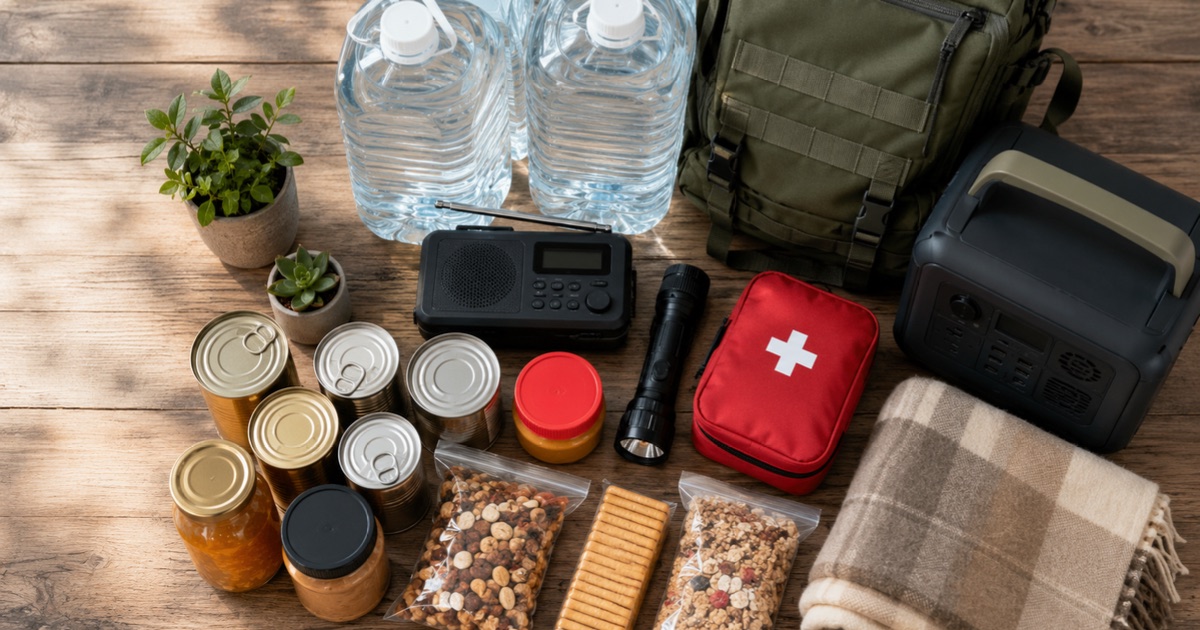
Start with what Ready.gov puts in a basic kit: water, non-perishable food, a flashlight, a first aid kit, extra batteries, a whistle, a phone charger and a backup battery. Then add:
- A change of clothes and comfortable shoes
- Medications for a few days
- Your document pouch from step 4
- Pet food and a leash, if you have pets
- Some cash
Our Best Bug-Out Bags and How to Pack One guide covers the bag itself. Our free Bug-Out Bag checklist makes packing easy.
9. Keep a Small Home Supply
Ready.gov's baseline is one gallon of water per person per day for several days. In a small apartment, that can fit in a closet or under the bed. Add a few days of food that doesn't need cooking. Our water math guide and budget prep guide help you do this without blowing your budget.
10. Know Your Way Out and Your Alerts
- Sign up for your county's emergency alerts. In California, the state points people to CalAlerts and Listos California.
- Know two ways out of your building, not just the elevator.
- Never drive or walk through flooded roads. The National Weather Service says "a mere 6 inches of fast-moving flood water can knock over an adult."
A Simple Renter Checklist
- Check your renters policy for flood exclusions.
- Ask about an NFIP contents policy (allow 30 days).
- Text your landlord your questions.
- Video your belongings and upload it.
- Waterproof your documents.
- Get things off the floor.
- Add a door draft stopper.
- Set up a portable power plan.
- Pack a go-bag.
- Sign up for local alerts.
The Bottom Line
Renting doesn't mean you can't prepare. It just means your prep focuses on what you control: your coverage, your records, your gear and your plan. Do one step this week and you're already ahead of most folks.
Grab our free printable checklists to get started. If you'd like the full step-by-step system, check out the Storm-Ready Survival Bundle.
Sources
- NOAA Climate Prediction Center, ENSO Diagnostic Discussion (Oct 8, 2026): https://www.cpc.ncep.noaa.gov/products/analysis_monitoring/enso_advisory/ensodisc.shtml
- FloodSmart.gov (NFIP), Buy a Policy: https://www.floodsmart.gov/get-insured/buy-a-policy
- FEMA news release on NFIP coverage: https://fema.gov/print/txt/node/330656
- Ready.gov, Floods: https://www.ready.gov/floods
- Ready.gov, Financial Preparedness: https://www.ready.gov/financial-preparedness
- Ready.gov, Build a Kit: https://www.ready.gov/kit
- National Weather Service, Before a Flood: https://www.weather.gov/safety/flood-before
- National Weather Service, Before a Winter Storm: https://www.weather.gov/safety/winter-before
- National Weather Service, Turn Around Don't Drown: https://www.weather.gov/safety/flood-turn-around-dont-drown